Introduction
I am a music hoarder collector - my MusicBee library will hit 50,000 songs this year - but I do use streaming a lot as well. I love discovering new music and broadening my tastes, and streaming enables that discovery. I’ve extensively used Spotify for over a decade now, but I have been checking other streaming services, which stemmed from a paranoia surrounding the 10,000 song limit from years ago that, while subdued a lot, still exists somewhat. The one that always caught my eye was Apple Music, which is essentially a streaming platform grafted onto Apple’s old iTunes infrastructure, with some bells and whistles here and there. And after using it as well as Spotify on and off for years, I can safely say that I’m mostly happy on it, but there are some major problems Apple needs to iron out.
This will mainly apply to the desktop client on Windows 11 since that is where I do most of my listening, but I also use it on mobile. Generally, iOS and Android have the same features, though Android did get crossfading before iOS did somehow. Mac users, sorry, but I don’t have enough experience on Mac. I will also compare it to Spotify since 1) it’s the leader and 2) it’s where I went to Apple Music from.
Commonalities
Let’s get the things they have in common over with:
- Lossless audio: If CD quality lossless is a priority, you can’t really go wrong with either. A lot of the bitching about Spotify not being “true lossless” tends to be from people who are beyond help and lament the lack of Exclusive Mode for Spotify on Windows. CD quality is perfectly cromulent for critical listening.
- UX: On the surface, they generally share the same layout - there’s only so much you can design for a music streaming service. They do both have their strengths and weaknesses in their differences however.
- Missing music: For one reason or another, mainly politics or record label incompetence, some music is missing from either platform and you’ll have to fill it with what you have.
- Dubious politics: Tim Cook is licking Trump’s old crusty asshole and Daniel Ek uses Spotify money to fund military AI. Frankly, it’s a matter of picking your poison, unless you’re into artists who have decided to boycott, such as Skee Mask or King Gizzard and the Lizard Wizard. Then I’d say, choose Apple Music as the protests have hit Spotify particularly harder. If you’re going to try and serve me ideological slop about “streaming bad”, then you’re falling on deaf ears.
The Good
A calmer user interface
Though they generally share the same layout, Apple seems to have executed it in a such a way that is very meditative in comparison to Spotify, focusing more on the music itself.
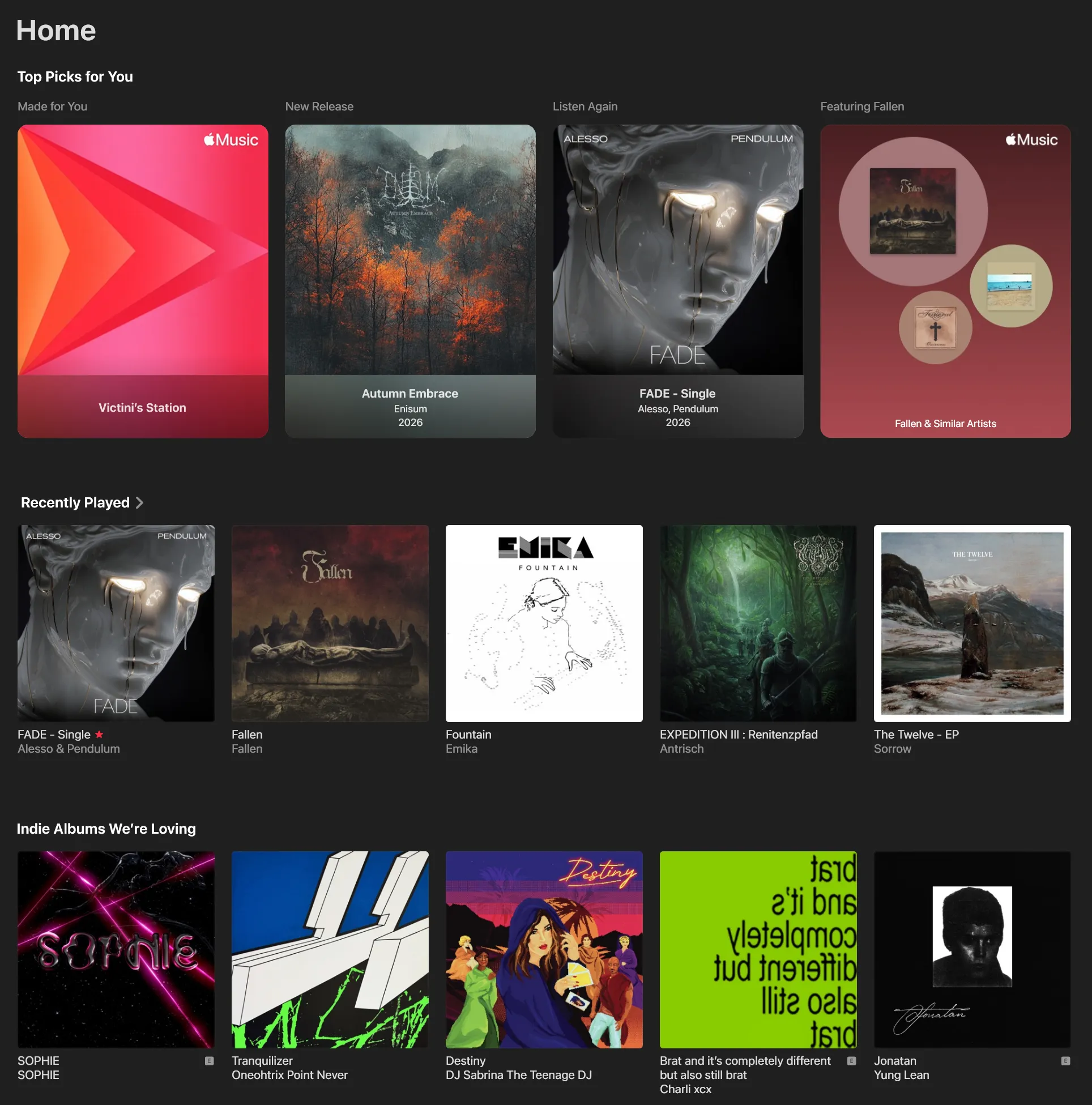
I am not a UI expert, though. All I can say that across the board, Apple Music is such a calm experience compared to Spotify, which feels chaotic. It feels like the UX makes me more inclined to skip tracks on Spotify in comparison. The general UI and UX on the mobile clients is great, especially in comparison to Spotify, and the calmness of Apple Music is carried on to the Windows client. I will link this post by Amish Gadhia which compares the mobile apps and explains Apple’s design philosophy better than I ever could.
Generous limits
While Spotify has unlimited liked songs now, unfortunately as I said before, their offline download limit is still 10,000. This is basically unacceptable on Spotify’s part, when the app is still tracking your offline playback. There is simply no reason to impose these limits nowadays. Playlists are also limited to 10,000 as well.
Meanwhile, Apple Music’s limits are very generous. I don’t know what the exact limit on playlists are (I heard it’s around 50,000) but the Cloud Music Library limit is 100,000. Depending on how you save songs to your library, that is pretty much virtually unlimited and for me, this satiates any anxiety I have, almost like I’m future-proofing myself. Furthermore, offline downloads have no limit, so you can download everything to your heart’s content.
Better local music handling
Using Spotify as an offline music player is basically like putting a square in a triangle hole, thanks in part to the aforementioned limits. Another aspect that leads to that is that uploading local tracks are a bit of a faff - they have to be downloaded from the desktop directly to the phone, and I have de-synced my Spotify playlists as a result of this. Meanwhile on Apple Music, it’s uploaded to the cloud and any client can access it and I don’t need to worry about it. The way that Apple Music handles this means I can have a solid streaming library, with my own local tracks to fill any gaps, and it’s not as awkward as how it works on Spotify.
And yes, I know local music players exist for iOS, and I have tried Jewelcase which is honestly a great app for this purpose that is completely free (with in-app purchases for donations). But transferring even a subset of my music from my Windows computer to my iPhone is a fucking nightmare - Apple Devices is absolute shite, and I had to resort to Blip for wireless transfer. If I need to go back to Spotify for any reason, I’ll probably do this, but why should I when Apple Music right now offers the better option?
Discovery-focused algorithm
I have been trying to get into extremer forms of metal. I’ve struggled to find some good extreme metal from Spotify since it focuses more on familiarity, and most of my recommendations circle around dance music. Meanwhile, Apple seems to have put my account in a cluster for extreme metal tastes and has no qualms just recommending it to me in the New Releases playlist. Spotify’s Release Radar is more focused on the artists you already listen to; Apple Music goes for what it thinks you’ll like alongside artists you already know. And as a result, I’ve found some new great artists in the genre, such as Antrisch.
Apple seems to focus on quality over quantity with their algorithmic mixes, while Spotify seems to have a virtually limitless amount of “Niche Mixes” that, while familiar, simply aren’t as good and at times become very questionable. Apple seems to focus more on specific moods instead - the Relax mix and the Chill playlist are my favourites, as they are amazingly well-catered. I also found On a Night Like This by Kylie Minogue by poking in the Love mix, and it’s now one of my favourite Kylie bops.
It’s worth mentioning that listens provide very minimal feedback to Apple Music’s algorithm, which favours proper signalling from the user to improve its selection - this is typically done by favouriting a song, album, artist, or playlist. If you’ve found the algorithm on Apple Music to be worse than Spotify, try this first before bailing.
Power user features
As Apple Music is basically an evolution of iTunes, the desktop client gets some extra goodies that are really nice to have. I would have to work around with Spotify by either coping about it not being a feature, or using a service like Soundiiz or exporting my library to CSV.
The first example is playlist view customisation. I maintain some “best of” playlists to share what my favourite songs have been in the years those lists were made in, with a one-song-per-artist limit. One thing I’ve started doing is using the Albums view to group them by album. Since I can have more than one favourite song from an album, it makes it easy to filter out the other noise, and figure out which song was my favourite.
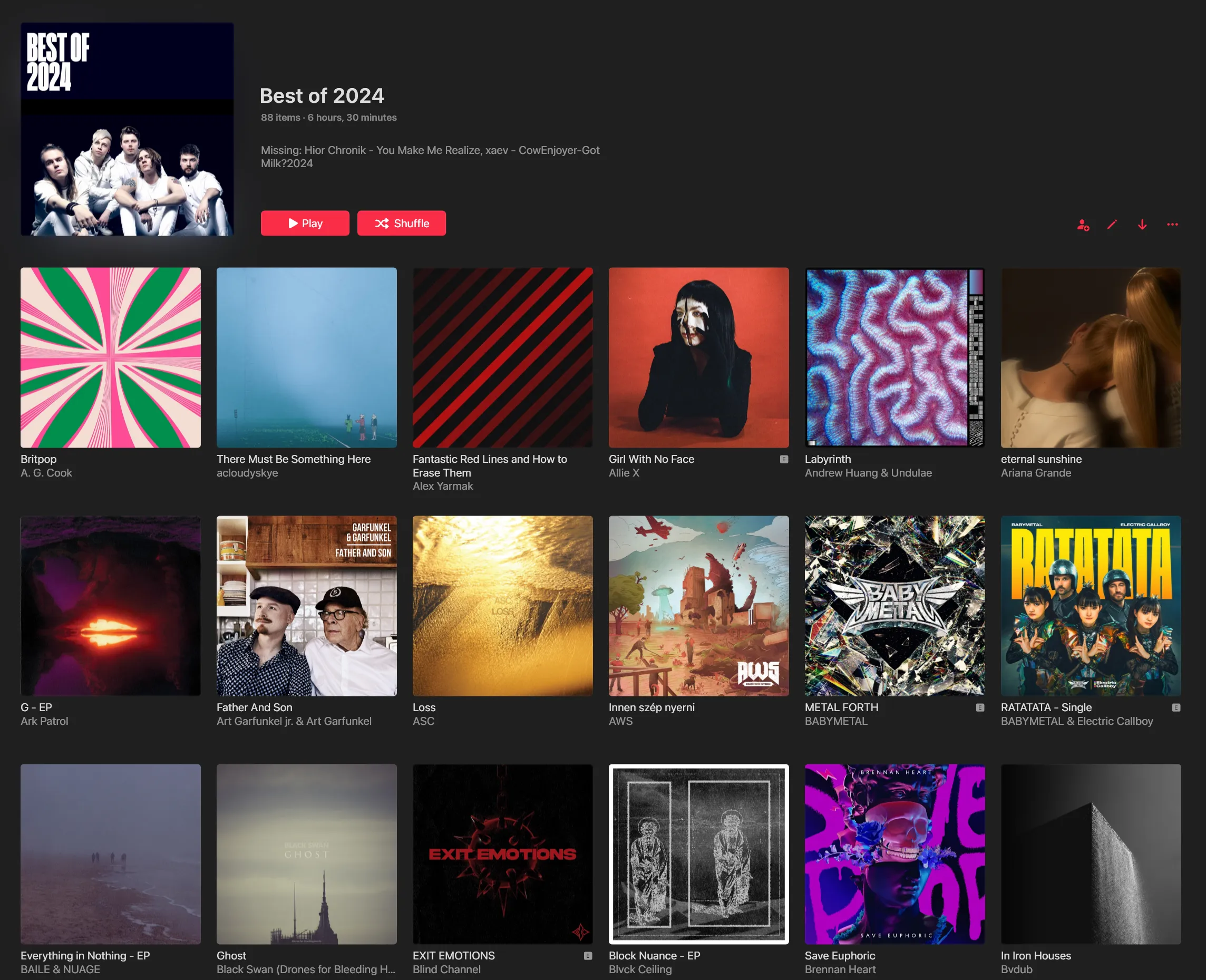
Your playlists also get the ability to have pretty “advanced” sorting that doesn’t exist on Spotify. If I need to find all songs I’ve favourited from 2026, I can simply sort by year in descending order, easy. Spotify only has ordering by title, artist, album, or the date it was added, which is simply limiting in comparison.
I haven’t used this that much, but it’s worth pointing out here: Smart Playlists have carried over from iTunes onto Apple Music for desktop, and can be played on mobile. For example, you can have a Smart Playlist that picks random songs you haven’t listened to for a while.
No identity crisis
Spotify seems to be trying to compete against YouTube by allowing video content, which is a far cry from an audio streaming platform. I was fine with podcasts and audiobooks being part of Spotify, but I can completely understand why people don’t like this. It just feels desperate. Meanwhile, Apple Music simply knows what it is and isn’t. It doesn’t advertise a bunch of unrelated shit you don’t need into your face. This is just simply good UX, which Apple is still known for to this day even as Liquid Glass was welcomed like a wet fart to Apple’s devotees.
While Apple has been slow to add some features Spotify has had before, such as concert tracking, they do still gear the service towards catering to the listener rather than treating them as a product. A great example is the lyrics feature, known as Sing. Not only does it look better on Apple Music, but you get word-by-word syncing like in karaoke. It’s a tiny feature that makes song lyrics much easier to follow. Meanwhile, Spotify at one point actually tried to limit the viewing of lyrics.
Apple’s playlists, whether human-curated or algorithmic - also have to get a shout-out. It seems like Apple’s editorial team employs people clued in the genres they highlight, from pop, to EDM, to ambient, to even extreme metal. Certain popular artists will have an algorithmic playlist showing their essential tracks (similar to Spotify’s “This is…” playlists) but also Deep Cuts for obscurer tracks, Chill for more relaxing tracks, or Influences for tracks that inspired the artist.
Now that the good stuff has been laid out, let’s go into the bad.
The Bad
Inconsistent feature parity and UX
It seems like no-one in Apple Music’s departments are really in sync with each other. I can understand not implementing features like Sing’s instrumental filter, as that generally relies on the Neural Engine in Apple devices, and Windows and Android devices generally don’t have an equivalent. But that is no excuse for features being missing or appearing inconsistently. Examples include:
- Desktop clients still not having word-by-word synced lyrics even though the web client does
- Android getting cross-fade before iOS
- Mobile devices not having the ability to update Smart Playlists.
It makes Apple Music feel really disjointed, especially with regards to the Windows client. Meanwhile, Spotify is generally excellent on this regard, with the mobile and desktop departments generally in sync.
Bad integration for “Now Playing” tracks
Apple Music doesn’t really have a good now-playing indicator in its API like Spotify does, which is a major problem for things like scrobbling/listen tracking or Discord rich presence. Instead, you’re having to rely on several apps for something the app vendors already have integrated thanks to Spotify’s API, and sometimes an update to the client can break it. This is the case with AMWin-RP, a utility for the Windows client that uses data received from .NET’s UI Automation library to broadcast your currently playing track to Discord, Last.fm and ListenBrainz, where I’ve had tracks not scrobble due to an update from Apple. There is also a limit within AMWin-RP where each app needs to be on the same virtual desktop, due to limits within the UI Automation library.
Now, Spotify can pull a Reddit and remove support for this, but they haven’t, and given that Discord has Spotify support, I highly doubt they will.
Social playlists are an afterthought
There’s a major lack of playlists from users on Apple Music in comparison to Spotify. Though there are some good playlists (Sonemic’s playlists are particularly good, based on data from Rate Your Music users) there’s not really much going on here. Furthermore, if you make a playlist public on Apple Music, it turns out that there is a 300-song cap when it’s shared. This is simply not on and I feel like Apple doesn’t really care for this.
One personal casualty of this is “It’s Somebody’s Favourite Song”, a playlist on Spotify comprised of songs people on RYM said was their favourite. I found some great songs here, such as Grouper’s Headache which is really calming in a way no other song does. I used an app to transfer it to my Apple Music account, and was planning to share the playlist… until I saw that 300 song cap. That simply ruins the point of that playlist in particular, which has more than 300 songs.
The state of the Windows client
I have spoken a lot of praise for the UX of Apple Music. I’ve griped a bit about the inconsistency of what features get added. But there’s one particularly ugly stain on Apple Music I have to talk about: the state of the Windows client, as good as it looks (especially since they’re combining Apple aesthetic with Windows’ UI).
For starters, Apple decided to forego any Apple-specific UI libraries from iTunes, and go full in on native libraries - in this case, Microsoft’s WinUI. While they balanced Apple’s aesthetic with the general theme of Windows pretty well, on Windows 11 WinUI makes apps feel clunky and Apple Music is one app that suffers a lot from this. It was so slow that I considered disabling animations on Windows entirely to make it faster, even though Apple Music is the only WinUI app I really use. In comparison Spotify, which uses Chromium Embedded Framework, is very quick and snappy, which is a bit weird. I’m constantly told that apps based on web frameworks are bloated and laggy, but here’s a native app that is slow and clunky, in comparison to an app that is basically a website running a web engine.
I wonder how many of those complaining about Electron, et al. are on Linux…Furthermore, when adding songs to playlists via dragging and dropping, which is slower than on Spotify because of the animations, it doesn’t actually show any sort of signal that the song was added. Spotify highlights which playlist you’re going to add a song to and even shows a little notification confirming which playlist has had songs added - a tiny detail that make an app more intuitive and accessible. The Windows client also suffers from odd unreliability trying to play a track, while Spotify is basically instant even when playing lossless tracks.
I have written to Apple via their feedback form, talking about these missing features, but Apple needs to sort something out with Microsoft about how slow and unreliable their Windows client is. As for the Mac version, which I’ve heard similar complaints about, I can’t say since my experience with Apple Music for Mac is much smaller in comparison.
No Linux support
This doesn’t apply to me specifically, but it does apply to anyone who is planning to use Linux.
Now, look… if you want to use Linux, you’re going to have to prioritise cross-platform applications while you’re on your current system, it makes the transition that much easier. And for streaming, your only officially supported option for Linux is Spotify, as Apple Music has zero support for Linux. While I can’t blame them - Linux’s market share percentage is still countable on one hand according to StatCounter and the Steam Hardware Survey - it does mean that on Linux, you will have to work around this, either by using:
- The official web client, which sucks ass - not even talking about the lack of lossless, I’m talking things like the queue not being instant or web browsers not reporting the current playing song correctly.
- Using a wrapper for the web client that doesn’t suck as bad but is written by people with very weird, if not straight-up problematic political takes.
- Using a virtual machine to virtualise Windows and then run Apple Music in there, which to some may seem like overkill.
None of these are particularly great options, especially compared to Spotify where you just install it, log in, and go. And frankly, given that the situation with music library players on Linux is so bad especially if you’re accustomed to something like MusicBee, Spotify is probably your only hope for a half-decent music library player at all.
Conclusion
Truth be told, there isn’t really a particular lock-in I have between the two, and I have admittedly bounced between them, especially recently. And while Apple Music has some major great features and UX decisions, there were also some things that make it stink.
But despite that, there was something keeping me interested in Apple Music. The power user features, the general calm nature of the UI and additional calmness from knowing I won’t hit any limits on downloaded songs made Apple Music pretty good, keeping me on it despite how clunky how slow the UI is. This is almost certainly not an Apple issue, and it could be fixed as Microsoft (claims to) de-enshittify Windows 11. Funnily enough, this downside also came with a funny upside: it makes me use MusicBee more, listening to my local music. It’s actually given me a stronger relationship with my local library.
I think I’ll stay with Apple Music for now as my main service, with Spotify for some of the missing or broken features. There may be a chance I’ll bounce back to Spotify entirely depending on what my future situation is, but for now I feel much calmer on Apple Music despite its problems.