Edits
- August 2nd 2026: Added comment in relation to slugcat.systems’ post. More moving around, adding more headings. PSVR2 finally got Linux support through Ignition, but honestly it’s still not worth it for me. (Respect to the PSVR2Toolkit devs though! They’re probably keeping the PSVR2 alive…)
- July 29th 2026: Trying to cut down on a lot of “filler” crap.
- July 21st 2026: Tweaked the virtualisation part and the community excuses for Linux part. Removed section on Claude in software problems.
- July 14th 2026: Changed some wording across the board, added stuff about Microsoft’s account requirement, added paragraph about game modding, added some stuff about stress, added a bad experience with a Linux User on Bluesky.
- July 8th 2026: Anthropic now has a beta of Claude for Linux, rendering a small part of the software problems void. I’ve also went back and made things less formal.
- July 4th 2026: Changed title from “My Problems with the Linux Desktop” to “Why desktop Linux sucks (for me)”, added section on Linux gaming, added ToC block
Let’s be real, Windows fucking sucks in places. I’ve had some nagging issues with it and I do feel like I don’t focus as well on it as I might’ve done on KDE. But at the same time, it’s also where I am the most productive at the moment, because despite all the crap Microsoft keeps trying to shove in and the rakes they keep treading and slamming their face on, everything still works.
People have been trying to spread the gospel of Linux for years, right now spurred on by plenty of tech influencers (and, uh, PewDiePie) saying that we all need to use Linux NOW. However, as someone who’s been trying Linux since the 2010s, and as someone who has used and donated to KDE, who would immediately jump at the chance to use KDE, and has had plenty of experience with Linux? Yeah, no, Linux is not the panacea at all, and for now I’ve pretty much decided to stick to Windows at the moment, and I’m even looking at going Mac for my main system. There are things that are fundamentally broken with desktop Linux that need to be exposed, and I want to cut through all the anti-Microsoft noise that strongly pervades Linux discussions. I know people are going to jump at me for this, or try to deflect the blame onto me or gaslight me over this – to those people: if room for criticism is not allowed in the Linux community, the people who are not only capable of fixing these problems, but also want to fix them, simply won’t show up and desktop Linux simply won’t get better. Part of Linux’s negative reputation is because of its community’s bad apples, and factored into why I stopped using Linux.
I will not be singling out a single distro – these problems are generally inherent to desktop Linux. Hardware problems such as ASUS motherboards having buggy power management code leading to Intel networking drivers panicking don’t count here, as they are going to be difficult to fix at its root without solving the chicken-and-egg problem, in comparison to software which can be theoretically fixed with new contributions – whether that be in WINE or in the form of a new app. I will update this as time goes by and new things develop.
Software problems
Missing software with bad/inappropriate alternatives
MusicBee, and the alternatives that aren’t
For me, music is important, and I use MusicBee and Apple Music for that reason. I touched on Apple Music in this context already (Sidra seems to be good if you want a free Apple Music web wrapper with Discord support, and you can try it on Windows or Mac), and I have a post about the features of MusicBee that I love. For MusicBee specifically, I have tried it in WINE, even maintained the MusicBee page on WINEHQ’s AppDB for a while, and ran into the following problems that haven’t been fixed as of my last testing:
- Tabs cannot be dragged.
- Each element of MusicBee is treated by WINE as its own window, meaning windows get popped up like regular windows in KDE. Annoying when the tooltip is classed as a window and ends up stealing focus from the main window!
- Imports are considerably slower than on Windows at times.
- Some cover art that’s high resolution just doesn’t show up whatsoever. A notable issue for any of you obsessive MusicBrainz lot who use the Cover Art Archive.
- Weird issues with UI repainting. (in fairness, this also happens on Windows, but happens more frequently on Linux).
One or two issues or the odd bug is fine, but when they pile up, it gets fucking frustrating, especially to an ADHD brain like mine. Bugs in WINE can take a long time to fix in comparison to bugs that affect Proton, Valve’s variant of WINE that comes with extras to increase compatibility for games specifically. There is financial incentive for bugs in Proton to get fixed – less so for bog-standard applications, and even then, MusicBee will be much lower on the priority list, as people yearn for proprietary creative suites like Creative Cloud and Affinity to get better due to how bad people feel the FOSS alternatives are. (GIMP is common, here, but the developers are listening)
At least with Apple Music, if I so desperately wanted the best experience while using Linux, I can simply use it on my phone or the web client (Sidra is pretty good at filling in the OS fundamentals that Apple does not/cannot). MusicBee however has no viable alternative on Linux. When I told this to an evangelist on Bluesky, they said that Linux has like 50 other players to choose from. The problem is, a lot of music players on Linux are too simplistic for me, and my return to MusicBee was not out of trying either. I did try to use alternatives, but frankly they were all bad for one reason for another, and I always kept running back to MusicBee:
- Quod Libet felt overwhelming for me, and had no playlist folder or tag hierarchy template support. The overwhelm came from the fact that stars are not condensed, meaning if you use the 5-star system with decimals (e.g. Rate Your Music, Google Reviews), you will have to stretch it to ten stars, which feels wrong. I had tried to convert RYM tag hierarchy template groups into queries for Quod Libet using an automated script, but this is a convoluted workaround and it even crashes the player if the group is too big. I don’t know if this is because of it being based on Python while MusicBee is C++ with some .NET goodies.
- Strawberry does not support multi-value tags which I make very extensive use of. This means features like the Genre Browser would combine tags into one, essentially crippling my music library. For example,
Electro House; Festival Progressive Housein MusicBee would be separated with a semicolon, but would becomeElectro House Festival Progressive Housein Strawberry as if it was one genre. A proposal to separate these genres was made but was quickly closed since it’d be a massive overhaul, and frankly, it doesn’t do the tag hierarchy feature anyway. - Tauon Music Box treats ratings like a second-class feature as the developer has an aversion to them, and ratings in Vorbis comment tags are not implemented as a result. I also had major issues trying to use its “generators” feature to make auto-playlists that corresponded to common tag hierarchy template groups I used. (it was the best looking of the alternatives though, I’ll admit.)
- gmusicbrowser did support star ratings the way I had wanted them, however it’s very old, and hasn’t caught up quickly enough, making its future uncertain. Furthermore, it doesn’t have a lot of the features from MusicBee I was missing.
- Cantata
iswas unmaintained (there’s a fork somewhere) however when I used it, I believe it only did ratings. I was used to this before MusicBee decided to implement tag hierarchies, which is a feature I make good use out of. - MPD is the tinkerer’s music player. I could probably get something to work here, but that requires a lot of time, which I’m starting to value more, and I don’t know of any decent .NET library for MPD.
MusicBee just does everything I want out of a music player, and nothing in the Linux space comes close. The friction from WINE was noticeable enough that I actually noticed myself using Spotify more, as it had a native client. That’s ironic, isn’t it? The so-called “anti-Big Tech” operating system’s best music library manager and player is a Big Tech platform. I’ve had people tell me I should know better when I posted about this, but it’s not my fault there’s no MusicBee equivalent on Linux.
That’s not to say Linux software and FOSS in general doesn’t have good stuff, but there is a reason that free and open source software gets criticised for its clunkiness. Even worse so if you’ve got That One App that is exclusive to Windows (or Mac, even) – you’re either fucked from it never being ported, fucked from having to work around bugs that simply do not exist on Windows, or fucked from having to deal with subpar alternatives and people trying to gaslight you that it’s even better.
Another anecdote: a friend of mine who is training to be a Linux sysadmin got so sick of desktop Linux for multiple reasons that he is planning a move to macOS, but he dipped his toe in first by messing with a virtual machine and using a music player called Doppler. He said that MusicBee felt a bit too overwhelming for him (which is fair) – Doppler was essentially his Goldilocks player, it suited him just right but had a similar user interface to MusicBee. During this time he noted that he too noticed himself using music streaming more while he used Linux, and from using Doppler he was able to finally understand my frustrations with the state of Linux music players. There is a reason there are plenty of threads on the MusicBee forums dedicated to trying to get MusicBee to work on Linux, with activity as recent as spring of this year. People yearn for a Linux-native MusicBee, and no-one is bothering to actually make that at the moment. It’s something I want to tackle, but given how bad Linux actually is for developers to target, I’m not so sure.
The rest
Other software I’ve used since writing this include:
- Microsoft Office – OnlyOffice is cromulent, but has some performance issues. Ditto for LibreOffice, but without the cromulent part because they seem to be ideologically opposed to Office Open XML which is better on the spreadsheet front than Open Document Format. I don’t care for your ideology when your app is clunky to use and spreadsheets are clunky. OnlyOffice meanwhile supports OOXML very well, enough I could actually use it if the performance issues got ironed out.
- The amount of drama going on with both LibreOffice and OnlyOffice also makes it worth more to just use Microsoft Office instead…
- Canva Affinity – I’ve used it to make an icon for an app I wrote, as well as make some thumbnails for this site. It’s intuitive and it works. I could probably have gotten by with Inkscape, but I couldn’t try it on Windows since GTK apps have weird DPI issues on Windows. If you’re going to try Linux, you’re best trying whatever FOSS software is available there, so this does not bode well.
- AutoHotkey – for replacing certain strings while writing. I don’t know of a Linux alternative that works perfectly on Wayland, which I go on about below
- Blip – basically a better LocalSend that doesn’t shit itself when you lock your phone. They are however working on a Linux version.
- Apple Music – “but didn’t you say Apple Music worked fine on web?” if you just stream, yes. Apple Music allows you to upload your own music into your cloud music library, and I basically use this to fill the holes that Apple can’t. The web client does not allow uploading of your own music.
The inevitable complaints about Wayland
My software woes also do not end there – I use a media organiser called Hydrus Network. It’s intended to be a local organiser styled like boorus (archival imageboards where files are organised with tags), and I use it as a giant archive/pinboard of things on the Internet that I like. Hydrus technically works on Linux – the UI uses Qt which is cross-platform and is the basis for KDE – but if you use Wayland (which, you probably are) it has issues if you use the mpv-based video player.
But, this needs a bit of context before I move on.
Desktop Linux is in a transitional state between two display servers, the software that handles how windows work, as well as other things like keyboard/mouse input and the clipboard. X11, which was the de-facto display server on Linux, is so old that it even predates Microsoft Windows by a year yet it was still used for many decades on Linux as things progressed elsewhere in tech. Due to its age there’s a lot of legacy cruft making it hard to maintain and add new features like fractional scaling (e.g. scaling a UI at 150% rather than 1x or 2x) and HDR, so the developers decided to start fresh with Wayland. Wayland was created as a way to replace a legacy system and future-proof it using a protocol-based system. And to say that the transitional period has gone entirely smoothly would be a lie, and I’m saying this as someone who knows that Wayland (or something) needs to replace X11.
Wayland decided to forego embedded windows inside other windows, which was how things were done in X11, and as a result mpv doesn’t know what to do when Hydrus loads it, it shits itself, and it makes Hydrus severely unstable. It’s bad enough that the developer had to warn its users on Linux about it. And it’s not like he can simply fix it alone either – to put things into perspective, UI toolkit developers have struggled with supporting Wayland until recently, so I do not expect a single developer who seemed to main Windows to deal with this and only recently gotten a Linux machine. The developers of Avalonia UI, a UI toolkit for .NET that works across the three big desktop operating systems (well, two – and Linux), wrote a post about how complicated Wayland really is and how they’re not just supporting one Linux, but different desktop environments that can’t agree on each other and end up making their own protocols to fill the gaps left by said disagreements.
Sidenote, if you use Hydrus on Linux, use QtMediaPlayer instead. It seems like Hydrus’ developer is moving towards supporting QtMediaPlayer more. It definitely fixes the issues I ran into when using mpv.
Which leads me onto this: because of how Wayland is structured, and because disagreements happen over things like system tray icons or window positioning, developers have lamented and ranted about how complicated it actually is to support Wayland, especially when sometimes, what app developers need isn’t what Wayland’s developers want. This developer wrote an entire angry rant focusing on how problematic the disagreements got and they summed it up better than I ever could (they’ll be on the links at the bottom too). This is also what frustrated me about desktop Linux – genuine progress is being held back because of a wrong ideological vision of how it should be and telling users and developers to cater to wrong behaviour, and reinventing the wheel in places they really shouldn’t. I’ve lost trust in Wayland as a result of this behaviour, and now I feel that Wayland simply reeks of the same issue as distros. For developers, like how there’s not one distro to target, there’s not one desktop environment to target either, and Wayland exacerbates this with desktop-specific protocols. It does feel like the Linux desktop, in trying to modernise itself, has taken several steps back in the name of ideology (which I’ll get to in detail later) with Wayland.
Another sidenote, when Wayland is criticised, it’s common to place systemd, an ecosystem for Linux that started as a service manager/init replacement, in the same group. There’s a weird group of “traditionalist” types in the Linux and BSD communities. To weed off those fucking weirdos, I’m going to say this: systemd isn’t perfect, but damn it it’s fantastic for what I need and want, and we should have more standards like it where everything is centralised into one ecosystem. Wayland, the distro concept as a whole, is the opposite of what Linux needs. It’s fragmentation without any real purpose.
The atrociously bad state of desktop virtualisation hurts Linux harder
I was very open to using a Windows virtual machine to fill some of the gaps in Linux’s functionality. Unfortunately, every solution here has problems. Desktop virtual machines are no longer the forefront in the virtualisation industry. They used to be back in the day, to run Windows apps on a Mac, but a lot of the focus surrounding virtualisation is the cloud, containers, and the datacenters. Unfortunately, when it comes to desktop virtualisation, it seems like only the Windows-on-Mac use case has survived, where both Parallels and VMware have offerings to run Windows 11 on Apple Silicon MacBooks (anything with an M-series processor rather than Intel). On Linux, it’s pretty dire.
VirtualBox has been generally unstable no matter what I use – for me, it crashed when running a Windows guest on Linux (particularly with graphics), and it crashed running a Linux guest on Windows, so that was an immediate no-go. VMware is actually really close and given that it’s free, it’s actually the best for virtualising Windows on Linux, but only in theory. In practice though, Wayland rears its ugly head again. A focus on privacy means that apps need your permission to access features like input and clipboard (mimicking some behaviours from iOS and Android), and given that VMware has not moved their app to Wayland and are instead relying on XWayland at the moment (which provides some backwards compatibility) this has never worked well for me at all. Passing on a clipboard from the host to the guest never works, while giving VMware the permission it needed locked up the entire system. The workaround here is to use KDE Connect inside the virtual machine. VMware is also harder to install on certain distros, as it has to build an out-of-tree kernel module (essentially a bit like a driver you download off the Internet, on Windows) which is only officially updated on a new major release, which means VMware can fail to run if the kernel gets updated. I’ve also experienced weird I/O choppiness with MusicBee (e.g. playing a song and then loading content from the shared folder).
And then there’s the native solution – KVM/QEMU, libvirt, it goes by different names, I guess. There are no drivers for the GPU on Windows like there is on VMware and VirtualBox, meaning it will be extremely slow in comparison to VMware. The solution to this is to basically attach a physical GPU to your machine, then use that on Windows while using experimental software to view the Windows screen instead of the native solution offered, or use a separate monitor. This is layers upon layers of workarounds that I don’t want to ever have to do, and it is absolutely insane to suggest that people spend money on an extra GPU, and time learning how this works, just to run That One App.
Linux gaming is not as seamless as you think it is, especially for popular games
The Steam Deck has ushered in a new era of Linux gaming, however it’s worth pointing out that if anyone is making a game that is native to Linux, it might not actually take desktop Linux into account. This happened to me when I tried to play Marble It Up Ultra on my PC. When exiting the game, it simply just crashes. Wrapping it in Gamescope fixed it, and this exposes a major problem with desktop Linux.
If I had to hazard a guess, it’s because the game was probably built to accommodate Steam Decks (and other SteamOS devices) rather than desktop Linux as a whole. I could probably just configure the game to wrap around Gamescope, but why should I when it works natively on Windows the moment I download it and hit Play? Some games may also have entire videos missing since Valve doesn’t enable certain codecs on Proton, showing a test screen when videos play. This showing up in place of the developer logos would be fine, but this also happened in games where the video plays a part of the plot (e.g. character introduction). Deltarune is a good example of this, in which Chapters 3 and 5 have character introductions using videos. Linux players would’ve likely missed the introductions of Tenna and Flowery. Apparently, the way to work around it is to enable H264 in Steam via a Chromium flag, but again – why does this need to be done? (rhetorical question, I know about patents)
Also, to go back to Deltarune, the game has a demo that is treated by Steam as a separate game to the paid version, meaning that the two games can’t see each other’s save files. Contrary to the ideology of Linux, this isn’t really a privacy sandbox, but rather a sandbox for WINE to handle Windows dependencies, as smushing them into one combined super-sandbox could potentially lead to weird problems. As a result, each game cannot see the others’ files when running in Proton. The workaround here is to either not play the demo at all and go straight into the paid game (which, in fairness, Deltarune has been great so far) or to drag the save files over. Since I played the demo, I did the latter. It’s a one time thing, but given the other issues I had with software, it piles up.
I’ve also heard issues across the board with game modding, and I can relate, even if this is also small in comparison to other people’s experiences. I play a game called FUSER, which was Harmonix’s music mashup DJ swansong before they became the Fortnite Festival company. Adding custom songs to that game requires adding a modded DLL the game looks for, that activates the mod. On Windows, it’s drag and drop and the mod works instantly, on Linux you have to ensure that WINE does not load its own version of that DLL, otherwise it’ll ignore that mod entirely. And I swear, it wasn’t even guaranteed on if it’d work, there were two ways to do it (through Protontricks, which lets you configure games that run in Proton, or through Steam’s command arguments).
PlayStation VR 2 support ain’t great at the moment (and dual-booting doesn’t make any sense for me)
I have a PlayStation VR 2 for VR, and it works perfect on Windows. It is also now compatible with Linux, using PSVR2Toolkit, a mod for the PSVR2 SteamVR driver, and Ignition, a fork of WINE designed for SteamVR Windows drivers. However, the developers of PSVR2Toolkit had to come out and say that Linux is not the saving grace of VR that people are making it out to be, singling out a bug in the Linux Bluetooth stack that they’re having to work around using code from their mod.
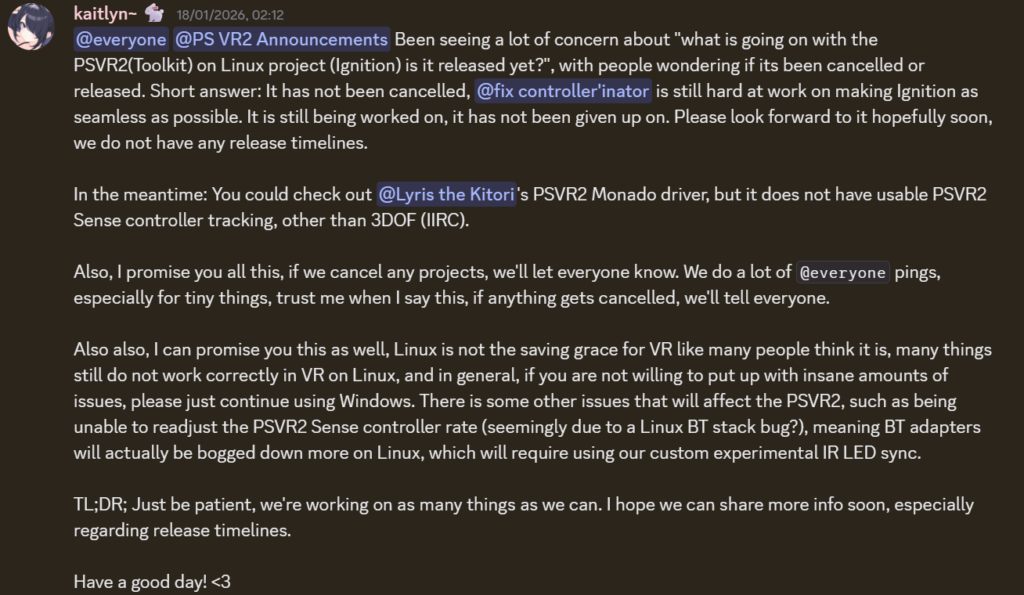
So, if I wanted to have the best experience on PlayStation VR 2, I’d need to use Windows and therefore dual-boot. A thing that’s annoying with Linux dual-booting specifically is that my GPU switches off the USB-C port on my headset when soft-rebooting from Linux to Windows, and I have to re-plug the headset in. It’s definitely an issue with how power is handled on the AMD GPU drivers on Linux, because rebooting to Windows directly doesn’t result in this. Not to mention, if I have to dual-boot, why not just use Windows instead where everything works? I have not only an OS where all of my apps work, but a decent development environment on top of that, and I can run Linux whenever I want.
A lot of Linux VR users tend to use a Quest (at least until the Steam Frame is out) with a tool to stream the VR game contents to the headset such as WiVRn or ALVR, but even so, this is a software issue that’s worth noting for those with a PSVR2.
Mental health problems (ADHD/OCD)
Some ADHD people get along with Linux just fine, and all the power to them. However, as I’ve gotten diagnosed and treated, and I learned more about myself, I’ve found out that Linux was constantly triggering symptoms of my ADHD and OCD, resulting in chronic stress and brain fog. This is something I really want to touch on.
The first symptom I want to highlight is perfectionism, and the constant tinkering to get it right. Both operating systems require a bit of annoying tinkering to get going. The difference, however, is that in my experience using both, a lot of that annoying tinkering takes place upon install for Windows, and then you forget that it was ever done in the first place. While Windows does try to get you using an online account to sign in, once you’ve worked around their strong-handing you can stick to that local account for as long as you like. On Linux, meanwhile, I had this constant barrage of things not working, trying to tinker to make it right, and my ADHD brain getting immediately irritated when it never gets to a satisfying point. Needless to say, I just kept wasting my fucking time. There are also a good few tools out there to automatically tweak Windows to get it to behave, even without having to manually use the command line. On Linux, between the Wayland glitches, dependency on WINE and lack of a good one-stop virtual machine application, I was constantly trying to tinker in the terminal it to get it to behave when it was basically impossible. It made me less productive.
The second symptom is decision paralysis, also known as analysis paralysis or ADHD paralysis. Per the ADDA:
Also known as analysis paralysis or ADHD shutdown, ADHD paralysis happens when a person with ADHD is overwhelmed by information, emotions, or their environment. As a result, they freeze and can’t think or function effectively.
I was constantly overthinking about the issues on Linux, and how to work around them, and what the best workaround was. It had put me in such an unhealthy, constantly stressful mindset to the point I was locking up and then offloading all my decision making about this to an AI chatbot (which, no matter your opinion on AI, everyone can agree this is a dangerous path). Ever since my diagnosis and treatment, I’ve noticed this a lot more as an ADHD symptom, which factored into why I felt I needed to stop.
The overthinking and the obsessive-compulsive perfectionism also fuelled the distro-hopping I had during COVID lockdown. I was swapping between Arch and Gentoo constantly, and there weren’t a lot of people telling me to stop. Not that I would’ve, I wasn’t diagnosed or treated for ADHD at the time, which fuelled my OCD symptoms, so it’d be like talking to a brick wall. If you’re running into this, I’d read this for advice, it’s a great little guide.
And, if you find yourself in this situation, take a step back and figure out what you really, actually, want. For me, I liked MusicBee more than I liked Linux, and favoured compatibility over everything else, so that factored in to why I went back to Windows. I still overthink about whether I should be on Linux right now, and the resulting stress and hesitancy is a clear sign I should not be using it at this time.
A third symptom that I don’t think gets touched on a lot is impatience. Some people are genetically impatient due to ADHD and this is something I have to deal with. Going back to the bugs that plagued MusicBee on WINE, I do understand that I need to wait for these bugs to be fixed if I can’t do it myself, that’s absolutely fine. I have no qualms or ill-will against the WINE developers who are probably already bogged down. But my ADHD does makes me impatient, and the best way for me to run MusicBee without any aggro is to run Windows, simple as that.
Community/ideology problems
You’re gonna have problems with Linux, and you’re gonna want to fix them. If you want to stay away from large language models and generative AI in general1, then my advice is to ironically stay where you are, because you will find yourself reaching for ChatGPT due to how toxic and ideologically extreme the Linux community is. Even if there are great people in the community – and I’ve met them, and become friends! – the toxic loudmouths will ruin the experience for everybody.
This isn’t inherent to just Linux, but is generally a thing that happens within the free and open-source software community. I’ve seen this with Fediverse users vs. Bluesky, for example. I’ve also seen evangelists of GIMP and LibreOffice acting spiteful when people reject their evangelism, saying they need the software that those two are trying to replace. A lot of what I’ll say here applies to a lot of FOSS generally, and it’s worth calling out.
Ideological extremism, FOMO, constant user-blaming
These people jump at any moment of Microsoft slamming their penis in the car door to talk about how Linux is an upgrade and generate FOMO towards non-Linux users. Like, it’s cool that your OS has little to no forced AI on it but… can I like, do my actual work on it without resorting to several workarounds? If I can’t work in two or less steps, then what’s the point? This gets glossed over a lot because a lot of Linux users got used to subpar software and workarounds, when to those outside it either doesn’t do the job at all or does it so unreliably that it doesn’t seem worth it.
And when Linux is criticised, they go straight to gaslighting and insults regardless of who is actually to blame. If you don’t shine their precious OS in a positive light, they’ll become dismissive and deflect the blame of the problems to you specifically, saying shit like:
- You chose the wrong distro.
- You chose the wrong hardware.
- You don’t need [app you really want to use here], [app that is nothing like the app you want] does what you need and then some!
- (this happens a lot with GIMP and it’s caused multiple discourses on Bluesky of all places…)
- You’re in a Windows mindset / you need to learn Linux.
- (as someone who used both and even tried to main Linux for years, this one seems the most offensive. It’s not a Windows mindset at all to use an app you love. I see this a lot towards people who actually *did* try to learn, too.)
- It’s free and open-source so fork it and fix it yourself.
- (never mind the fact that not everyone can code, or has the money to pay people to do this. I hope anyone who says this has to deal with an onslaught of vibe-coded slop, including developers.)
- Why do you need this? You use Linux to escape [feature that you actually want]/Linux not having [feature] is actually a feature!
You get the idea. They not only want you on Linux, they also want to control your use of it like an authoritarian government. This has been something that has been highlighted on Linus Tech Tips’ 2026 Linux challenge – twice! – as well as other people like DankPods, who were trying to find support for their issues and ended up reaching towards friends (in the case of DankPods) or LLMs (in the case of Luke on the LTT video).
There’s this undeniable cult mentality, where people shape their identities around Linux and create fragile, conditional connections reliant on herd mentality masquerading as proper relationships, and I think that is part of what’s causing a lot of the toxic behaviours we see and think of with regards to Linux’s community (and the overarching FOSS community). When Linux or [insert favourite big FOSS project here] is criticised they will see it as a personal attack against them and their tribe, and they’ll attack you for it. At the same time, they love attacking projects they feel doesn’t fit the Linux Vibe (whatever the hell that is), which in turn frustrates developers whose social skills may not be the best. It’s why I mentioned systemd earlier, to weed out those sorts of people.
On that note, some of the mentality of Linux users is also seen amongst developers of the software in this ecosystem, for example in certain Wayland protocol discussions when they don’t feel like implementing a certain protocol, or even GNOME’s attitude, which seems to be a toxic cycle of “do something no one wants -> gets criticised -> dismiss criticisms -> people get angry and express said anger -> GNOME becomes more insular and reluctant to criticism”. This is not a healthy development environment. You can say all you want about how you can avoid the community by using an LLM, but the truth is, it’s basically impossible to avoid the community because they’re also the ones developing on and influencing the direction of desktop Linux. Alec from Technology Connections sums it up perfectly here:
And it leads me to this: ideological extremism is actively hurting desktop Linux. There’s no ifs or buts about it. I know for a fact that desktop Linux and FOSS in general can be better even when compared to Windows, KDE already proves that. A lot of progress with desktop Linux would’ve been made had the ideologues that form the community got their heads out of their asses and worked more pragmatically. It’s not just with political ideologies like with privacy either, as alluded to earlier this hurts Wayland. GNOME’s strong ideology of their vision of the Linux desktop leads to a lot of the anger that goes their way.
There’s a reason that the drive for desktop Linux was from Valve working to fill their wallets full of Counter-Strike gambling money by making their own dedicated gaming platform, but also making that code open-source so it ends up trickling down to those outside the Steam ecosystem. It’s also the reason why Fedora is as good as it is, despite its strict FOSS agenda, since they are funded by Red Hat (who have their problems, but I can’t say they aren’t doing bad with Fedora). It’s a bit like the yin-yang concept, where there is balance between two wildly opposing forces by inheriting a part of the other. Desktop Linux simply does not have that balance at the moment, and until it does people will still see it as the weirdo terminal OS.
My personal experiences
I can provide my own experiences – when I used Arch (or CachyOS, rather), I wanted to use a blue light filter that activated from the sunset times of my local area. I was trying to figure out why the hell it wasn’t working and ran into this thread which had a guy saying he won’t use this feature, and he doesn’t help the original poster whatsoever. Privacy is inherently a good thing, but posting like this makes you look like a fucking dickhead and actively harms whatever cause you’re proselyting. I don’t see an issue with KDE wanting to use my location to check the weather or find sunset times for a colour filter, and I am not threatened by a desktop pinging a web service for my location to provide real features like blue light filters and weather forecasts. As Fake Linus said, this is not your choice, this is my choice.
That response irritated me enough to write my own post about what was happening and what needs to be done, for the odd person on Arch or Cachy or whatever flavour of the month Arch-based distro having an issue with this.
I posted about these concerns on Bluesky, and I had some twat say that he felt sorry for me because I had a flawed ideology and deep down, I knew it was flawed. Not really, I just got tired of ideology causing the OS I wanted to use to constantly step on rakes. To add to the twattery, he reply-gated and disabled replies, leaving me with no avenue to tell him to fuck off. This guy did this to the training sysadmin friend too.
This to me, is my most memorable experience of the Linux User. It’s this behaviour that makes desktop Linux feel deeply unserious, and it’s why I’m considering myself “allergic” to ideology. It’s fine to make choices based on your principles, but when using your computer daily turns into a political statement, you start to go insane and look like a twat, like that guy who targeted me and the friend.
The danger of the Linux community’s ideological extremism
This isn’t just applicable to Linux/FOSS, but it’s a point I really want to hammer home as someone who has been dealing with symptoms of OCD. I was talking to a friend who wanted to run a Nextcloud instance to pry their files away from Big Tech, however he didn’t want to pay for a domain name, which Nextcloud requires. I told them my honest thoughts, and that if you’re not doing it for the fun of it, it’s not worth it. This was the responsible action on my part because I noticed that this drive wasn’t coming out of anything other than anxiety, which could develop into obsessive-compulsive behaviour. I know this because dealing by myself with OCD symptoms, I’ve learned and can notice the mental behaviours consistent with OCD.
Ideology is a great breeding ground for anxiety disorders like OCD, and the Linux/FOSS ideology as well as the ones that surround it are no exception. One aspect of OCD is a fear of uncertainty, which ideologues love to exploit even if not explicitly, and with a sense of urgency. Some people with OCD have this about their religion thanks to the extremists that ruin it for others, and have a strained relationship with it as a result. My problem with how these sorts of people act is that they fuel the thoughts and feelings that OCD, indirectly and especially actively. The constant proselyting of their ideology, notably with privacy and being against Big Tech, fuels paranoia that can lead to unhealthy anxiety disorders like OCD, and given how actively political and ideological this community is, and the cult mentality I mentioned earlier, this only adds more fuel to the anxious fire.
The idea of self-hosting your own cloud storage is rooted in data sovereignty and privacy, the respective ideas that no-one except you will be able to control your data, and that your private data stays private. I don’t want to dismiss these principles entirely as there is validity to them, but that’s also why these principles create a great breeding ground for things like OCD.
The way to deal with this is not to go all-in on Nextcloud (you wouldn’t be thinking straight setting it up, anyway) – the way to deal with this is to accept the uncertainty, and make a proper, calm decision later. You might not end up actually setting that up, you may end up thinking it’s not worth it, but it’s the right way to go nonetheless. And that’s why I gave my honest thoughts. If these principles were strongly driven by anxiety, this can lead to paranoia and constant “what ifs”, the latter being a core driver of OCD and something I have seen happen online. I’d rather risk offending someone by being honest here, than let them go down a dangerous path.
I am not saying we should just stick to OneDrive and let Microsoft spy on us, we can and should strive for better, but going to the other extreme instead of working pragmatically towards that goal will also make you go insane, and insulting me will not change that.
Why I used Linux, and why things feel sour now
People may be wondering, if I wasn’t using Linux back then because of a political agenda against Microsoft, why did I use it? As I said before, I was on and off with Linux since the 2010s. It was, ironically, due to Windows breaking, but that was still a pragmatic solution given where I was at the time.
The way I got my start was because Windows Vista decided it didn’t want to work with my peripherals, and I had a CD with Ubuntu ready from past testing (this was before USB boot became mainstream). I came for the teenage curiosity, from an opportunity, and stayed because Compiz was genuinely amazing. I don’t think I was exactly tuned in to the “anti-Microsoft” ideology that much back then. Maybe an “anti-Vista” one and certainly an anti-Apple one when I had an Android phone, but I was soon testing Windows 8 later (which explains why I didn’t get the hate) and even turning my PC into a Hackintosh (PC that runs a Mac OS) back then. My anti-Apple ideology turned into apathy (and eventually, me buying an iPhone because I hated Samsung’s 2019 One UI). I was just a naturally curious teenager with an autistic fixation on computers. I didn’t care about GNU/Linux and as an adult I think calling Linux this is fucking stupid. I just liked Linux back then because my teenage brain found it cool, and Vista breaking in spectacular fashion presented an opportunity.
And I think that’s what made the whole attitude of the community sour for me. Linux for me was supposed to be fun, not a political statement, especially back in my teenage years. When I started, I was 13, and had never gotten involved in politics at all. I think as I tried to cling onto the hope that the funner desktop will Get There, I may have adopted some ideological behaviour myself to try and fit in, and I’m glad I’ve been stopping that bullshit. Besides a small group of people I’ve bumped into on Bluesky and one guy on Reddit who says he just uses Linux because it’s what he’s used to, there’s not really a community I’ve found that isn’t using Linux ideologically, and it makes for a very toxic environment.
And it’s not like some of these people don’t have a point – they’re just way too aggressive about it. I will say that Microsoft’s insistent strong-arming regarding online accounts did create that drive for Linux in me. I don’t want to have to login to my PC via a Microsoft account, it offers no benefits for me and I’ve heard people’s OneDrives getting filled up because of this when the user didn’t consent. Also, I use iCloud. But that’s easy to ignore even now when I can just bypass it using Rufus, a utility for copying installer ISOs to USB, and uninstall OneDrive post-install. Even the GDID controversy spurred from the arrest of a member of the Scattered Spider hacking group relied on using a Microsoft account (and Microsoft Edge) for the feds to catch him. Using debloaters and patching tools are to me a much smaller price to pay, compared to the problems I had on Linux, with a community insistent on blaming the user for everything when even deep down, they know that’s not the case.
Conclusion
On discussions online I see people saying “I’m too dumb to use Linux” and I just want to reach through to them from my screen, shake them and say, “no you’re not, it’s simply not appropriate for you right now”. Yes, Windows has its problems, but between the awkward transition period, dependency on Windows apps, and the constant analysis paralysis, desktop Linux always felt like it was in a state of 90% there for me, and there was always something keeping it permanently stuck for no actually good reason. No-one should blame themselves for being hesitant to try it, especially if their access to spare machines or even time is limited. The guy who made this quote is a bit of a twat also, but there’s a common quote that Linux is free, if you don’t value your time.
I remember talking to a friend about my frustrations with distro-hopping in particular. This guy has helped out on the Linux kernel, and he’s generally a pragmatic and calm guy. He raised a theory then that I was actually not satisfied with Linux, and while that didn’t sink in at the time – my brain still wanted to cling onto it – I completely get what he said now. Windows is fine for me at the moment, but I was never really happy on Linux. I’m on Windows 11 for the time being and right now, it’s the better – and even healthier – option. There are things that annoy me, but you cannot argue with “it just works”. The overthinking still happens generally, but I’ve been trying to get better at it and now I have no need to boot Linux bare metal. If I am to approach Linux, dual-boot or not, I’d need to want it so much its problems and overthinking doesn’t matter, and right now that is not the case.
Could my problems be fixed? Well, some of it. Things will get better, even if slowly.
- .NET has a chance to be the next big cross-platform SDK, with Avalonia supporting Linux and even testing Wayland support in its latest version, and Qt working on programming language “bridges” that include support for .NET on Windows and Linux.
- There are drivers being worked on to bring virtual GPU functionality for Windows onto KVM virtual machines, and while slow at least there’s something going on.
- Bazzite seems the closest to a one-stop Linux OS that works, along the lines of SteamOS. There is progress being made to make it even easier for new users.
- MusicBee did have a bug fixed in WINE – a notable one being that font redirection partly works, enough so that text from East Asian scripts now show up instead of showing up as boxes.
- Apple may not want to port Apple Music to Linux, but Sidra does close a lot of the gap while being free (as in beer and speech). I gave the Apple Music web client a go on Windows, and while there were things that were broken or not responsive (e.g. songs list playing only what is visible, playlists with 1,000+ songs not playing immediately), the experience is good enough for album/mix listening and even some light playlist editing.
However for as long as ideology overweighs pragmatism instead of any form of balance, the Linux desktop will be perpetually stuck at “90%” there for a lot of people.
Useful Links
If you liked this, you may also like:
- Why Linux is not ready for the desktop, the final edition. (Artem S. Tashkinov) – great lengthy post from a FOSS contributor that goes into more objective and deeper issues, was one of the inspirations for me to write this, alongside a bunch of Reddit users detailing their move back to Windows I found while producing drafts of this.
- Linux Desktop Issues (slugcat.systems) – veeery strongly worded rant about how Linux is a much harder target for developers compared to Windows, and some of the dumber decisions made at the “lower level”, so to speak. The rant about Wayland exemplified its problems enough for me to link earlier.
- Funnily enough, when looking this up I saw a response from two Linux users on Hacker News, and one of them dismissed this entire blog post solely because they said they used Ubuntu. Literally putting their head in the sand, and why a good chunk of my complaints are about the community. The other one was talking about how .NET is very Microsoft-y but honestly .NET and Avalonia together are really good if you want cross-platform.
- NixOS made me go back to Windows (Felix Sanz) – another inspiration, goes more into the issues with NixOS specifically (it’s… not like other Linux distros) but does explain why Windows has become more enticing.
- The atrocious state of binary compatibility on Linux and how to address it (JangaFX) – technical but good nonetheless. This is from a company made of former game developers who are now in the VFX industry. If you’re wondering why Linux’s backwards compatibility is a bit crap, this is part of the reason.
- Linux is still not for me (dragon.gal) – Another inspiration to make this post. Funnily enough, this person also mentions MusicBee as a reason, resorting to Navidrome.
- $100,000 in Studio Gear. Linux Killed It. (SpectreSoundStudios) – Great video underlying the issues with Linux from the perspective of someone in the general creative industry and specifically music production.
Footnotes
- I’ve noticed some people – even experienced tech people – throwing agentic coding assistants on their desktops to try and fix Linux problems. In a way, we can thank Anthropic and OpenAI for helping with the new Year of the Linux Desktop. ↩︎